
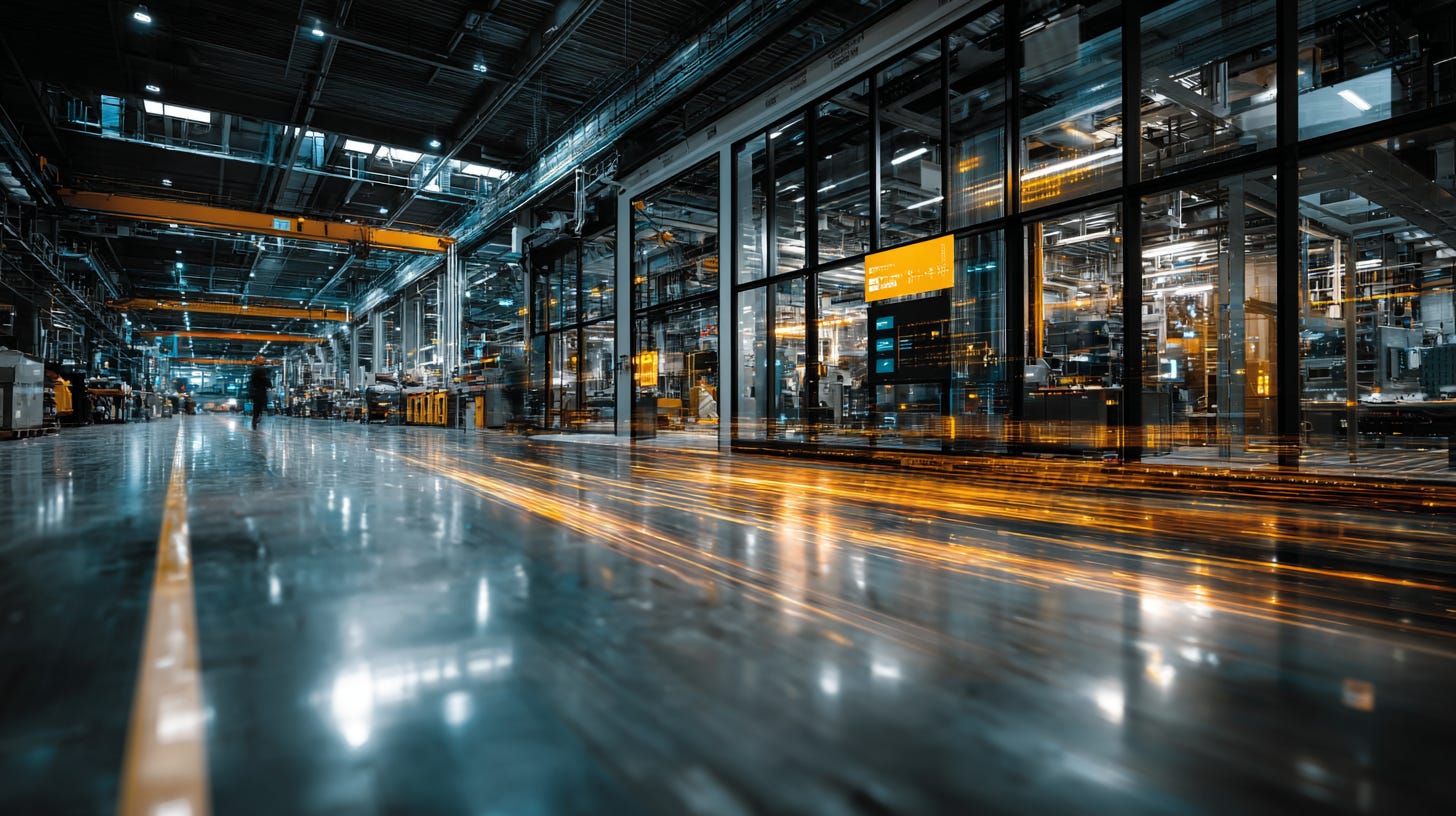
AI is making operations faster. That’s the easy part.
Planning cycles that once took days now take minutes. Reports appear instantly. Schedules recalculate in real time. Decisions that used to require a room full of people now come out of a model before half the people have opened the slide deck. Those gains are real, and they matter. Current industrial and professional signals reflect exactly that push: Hannover Messe 2026 is centering industrial AI, automation, robotics, and digitalization as practical competitive tools, while PMI is framing AI as a force for streamlining execution and enhancing decision-making.
But speed is not the same as improvement.
That distinction sounds obvious until you watch what happens in real operations. A process gets faster, utilization goes up, planning effort goes down, dashboards look cleaner, and everyone assumes the system got better. Sometimes it did. Sometimes all that happened is that the organization got faster at executing the same flawed logic it already had.
That is the uncomfortable part of AI in operations: it does not improve the system by default. It amplifies whatever system is already there—for better or worse.
This is where Industry 5.0 becomes useful, because it changes the question. Industry 4.0 largely asked whether we could connect, automate, instrument, and optimize. Industry 5.0 asks whether those capabilities are producing systems that are human-centric, resilient, and sustainable. That is how the European Commission explicitly frames it: not as a rejection of Industry 4.0, but as a complement that pushes industry beyond speed and automation toward better overall outcomes.
In plain English, Industry 5.0 asks a harder question than Industry 4.0 did.
Not “Can we automate this?”
But “Should we optimize it this way, and what happens to the wider system if we do?”
That sounds philosophical until you see it on a plant floor or in a planning group.
Take a familiar example. A company rolls out AI-assisted scheduling across a production network. The system optimizes for throughput, machine loading, and utilization. It responds faster than any planner could. Within a few weeks, the visible metrics improve. Planning time drops. Utilization rises. Output ticks upward. Someone inevitably says the word “transformational,” which is usually a sign to reach for coffee.
Then the secondary effects show up.
Work-in-process starts rising between operations. Downstream teams get hit with uneven flow. Expedites creep upward. Experienced planners begin overriding certain recommendations. Customer delivery performance stalls, or worse, slips.
Nothing is broken in the technical sense. The AI is doing exactly what it was told to do. The issue is that management encoded an incomplete objective into the system. The model optimized what was defined and ignored what was not.
That is not really an AI failure. It is a management decision, expressed mathematically.
And that is the point more operations leaders need to hear. Most AI disappointments in operations are not failures of machine intelligence first. They are failures of system definition, measurement, and judgment. The model is often faithful. It is the objective that is narrow.
Industry 5.0 helps because it forces the organization to look at the parts of performance that are easy to neglect when efficiency becomes the main story. Human judgment stops being treated as annoying friction and starts being treated as signal. Repeated overrides stop looking like noncompliance and start looking like evidence that the system’s assumptions are incomplete. Resilience stops being a nice extra and becomes a design requirement. The European Commission’s Industry 5.0 work repeatedly emphasizes that broader frame: human-centricity, resilience, and sustainability are not side constraints; they are part of what good industrial performance means.
This is why AI is not replacing Lean, Six Sigma, BPM, or project management. It is changing how they have to be applied.

Lean still matters because flow still matters. Six Sigma still matters because variation still matters. BPM still matters because structure and handoffs still matter. Project management still matters because somebody still has to translate ambition into execution. What changes is that AI speeds up observation, analysis, and response, while Industry 5.0 raises the standard for what “better” actually means. PMI’s current AI positioning and ASQ’s 2026 Lean and Six Sigma conference themes both point in that direction: the conversation is shifting from method purity toward AI-enabled, data-driven improvement that still requires human judgment and responsible application.
A simple test helps.
If AI is now making decisions faster in your operation, ask three questions. What decisions got faster? Which outcomes actually got better? Where are experienced people still stepping in to correct the system?
That last question is often the most revealing. If operators, planners, or supervisors repeatedly override an “optimized” system, the answer is not automatically that they need more training. Sometimes the operation is telling you, quite clearly, that the model is solving the wrong problem.
That is why the real promise of AI in operations is not automation alone. It is better judgment at scale. Faster analysis matters. Faster response matters. But if the system is still optimizing narrow metrics while pushing variability, fragility, or hidden cost somewhere else, then the company has not become more operationally intelligent. It has simply become more computationally efficient.
AI will make operations faster whether companies are ready or not.
Whether it makes them better depends on whether leaders are willing to question what they told the system to optimize.
That is a much harder job than installing the technology.
It is also the one that matters.
References
European Commission, Industry 5.0: Towards a sustainable, human-centric and resilient European industry.
European Commission, Industry 5.0 overview page.
European Commission, news release on Industry 5.0 and its focus on resilience, sustainability, and worker wellbeing.
Hannover Messe 2026 press release, Industrial AI as competitive game-changer.
Hannover Messe, Industrial AI topic page.
PMI, Artificial Intelligence in Project Management.
ASQ, 2026 Lean and Six Sigma Conference.